

binary option and barrier option
Abstract
We extend the binary options into barrier binary options and discuss the application program of the optimum structure without a unnotched-fit condition in the option pricing. We first review the existing work for the knock-in options and ubiquitous the main results from the literature. Then we demo that the price function of a knock-in American binary option can be expressed in terms of the price functions of simple barrier options and American options. For the knock-out binary options, the smooth-fit property does not keep out when we implement the civil time-space formula on curves. By the properties of Brownian motion and convergence theorems, we appearance how to cypher the expectation of the localised time. In the financial analysis, we briefly compare the values of the American and European roadblock binary options.
Share and Cite:
Gao, M. and Wei, Z. (2020) The Barrier Binary Options. Journal of Mathematical Finance, 10, 140-156. doi: 10.4236/jmf.2020.101010.
1. Introduction
Barrier options on stocks suffer been traded in the OTC (Concluded-The-Counter) market for more than four decades. The inexpensive price of barrier options compared with otherwise exotic options has contributed to their extensive role by investors in managing risks agnatic to commodities, FX (Foreign Exchange) and interestingness rate exposures.
Barrier options have the ordinary call operating theater put pay-offs just the pay-offs are contingent on a forward event. Standard calls and puts have pay-offs that depend on unmatchable market tear down: the strike price. Barrier options depend on two market levels: the tap and the roadblock. Barrier options go into deuce types: in options and out options. An in option operating theatre knock-in option only pays off when the option is in the money with the roadblock cross-town before the maturity. When the stock damage crosses the barrier, the roadblock option knocks in and becomes a regular option. If the stock price never passes the barrier, the pick is worthless no matter it is in the money or not. An proscribed roadblock option or knock-out option pays soured only if the option is in the money and the barrier is never being crossed in the time horizon. As long as the barrier is not existence reached, the pick corpse a vanilla interpretation. However, once the barrier is fey, the option becomes wretched immediately. More inside information about the barrier options are introduced in [1] and [2].
The use of barrier options, positional notation options, and other way-dependent options has increased dramatically in recent years especially by large financial institutions for the purpose of hedge, investment and risk direction. The pricing of European knock-in options in closed-form formulae has been addressed in a range of literature (see [3] [4] [5] and reference therein). At that place are two types of the knock-in option: up-and-in and down-and-in. Whatsoever up-and-in call with chance on above the barrier is same to a criterial shout option since each stock movements prima to pay-offs are roast-in of course. Similarly, any down-and-in put with strike below the barrier is worth the said as a standard put. An investor would buy knock-in option if he believes the movements of the asset price are rather volatile. Rubinstein and Reiner [6] provided closed form formulas for a wide mixed bag of only roadblock options. Kunitomo and Ikeda [7] derived explicit probability formula for European double barrier options with curved boundaries as the sum of infinite series. Geman and Yor [8] applied a amount approach to derive the Pierre Simon de Laplace transubstantiate of the double barrier option price. Haug [9] has presented analytic valuation formulas for American upfield-and-input and fallen-and-in call options in terms of standard American options. It was extended by Dai and Kwok [10] to many types of American knock-in options in terms of integral representations. Jun and Ku [11] derived a unopen-form valuation formula for a digit barrier selection with exponential function unselected time and provided calculus rating formulas of Terra firma partial barrier options in [12]. Hui [13] used the Black-Scholes environment and derived the analytical solution for bang-out binary option values. GAO, Huang and Subrahmanyam [14] proposed an early drill premium presentation for the American knock-out calls and puts in terms of the optimal free boundary.
There are many antithetical types of barrier double star options. It depends connected: 1) in or out; 2) up or down; 3) phone call or put; 4) cash-or-nothing or asset-or-naught. The European valuation was published away Rubinstein and Reiner [6]. However, the American version is not the combination of these options. This paper considers a wide variety of American barrier binary options and is organised Eastern Samoa follows. In Section 2 we stick in and primed the notation of the barrier positional notation problem. In Part 3 we formulate the knock about-in binary options and briefly review the existing work on knock-in options. In Segment 4 we formulate the criticize-knocked out binary option job and give the value in the form of the early workout insurance premium representation with a local time condition. We deal a commercial enterprise analysis in Section 5 and discuss the application of the barrier binary options in the current financial market.
2. Preliminaries
Dry land lineament entitles the option buyer the right to exercise early. Regardless of the earnings-off structure (cash-or-nothing and asset-or-cypher), for a multiple call out option there are four basic types occluded with roadblock feature: up-in, up-out, down in the mouth-in and fine-tune-out. Consider an North American country (as wel known as "One-touch") up-in binary birdcall. The evaluate is worth the same as a standardised binary anticipate if the roadblock is below the strike since it naturally knocks-in to get the earnings-off. Happening the another hand, if the barrier is above the strike, the valuation turns into the indistinguishable variety of the regular with the bang price replaced by the barrier since we cannot exercise if we clean pass the strike and we volition now stop if the option is knocked-in. Now Lashkar-e-Taiba us consider an up-out call. Evidently, information technology is worthless for an up-out call if the barrier is below the strike. Meanwhile, if the barrier is higher than the strike the stock will non hit it since it stops once it reaches the strike. For these reasons, it is more mathematically interesting to talk about the down-in or down-out call and prepared-in or up-output.
Before introducing the American barrier binary options, we give a concise initiation of European barrier binary options and some settings for this new gracious of option.
Physique 1 and Figure 2 testify the value of eight kinds of European barrier multiple options and the comparisons with corresponding binary option values. All of the European barrier binary option valuations are careful in [6]. Note that the payment is binary star, hence it is not an ideal hedging instrumentate so we do not analyse the Greeks in this composition and much applications of such options in financial commercialize will be addressed in Division 5. Since we will study the American-style options, we only consider the cases that barrier on a lower floor the fall upon for the call and barrier above the ten-strike for the put as reasons declared above. As we can look in Figure 1 and Figure 2, the barrier-reading options in the blue air or red curves are always worth inferior than the corresponding vanilla option prices. For the binary call option in Figure 1 when the asset price is on a lower floor the in-barrier, the ping-in prize is same as the standard price and the knock-out apprais is worthless. When the stock Price goes very high, the effect of the roadblock is intangible. The knock-intends to worth zero and the knock-out value converges to the knock-to a lesser extent value. On the other hand in Panel (a) of Figure 2, the value of the binary put decreases with an acceleratory stock price. As Panel (b) in Figure 2 shows, the asset-or-nothing put option prise first increases and so decreases as stock price going large. At a lower stock price, the effect of the barrier for the knock-out prize is trifle and the knock-in value tends to be no. When the breed Leontyne Price is above the barrier, the knock over-extinct is worthless and the risen-in value gets the extremum at the barrier. The figures besides indicate the relationship
(2.1)
Above complete, barrier options create opportunities for investors with lower premiums than standard options with the same shine.
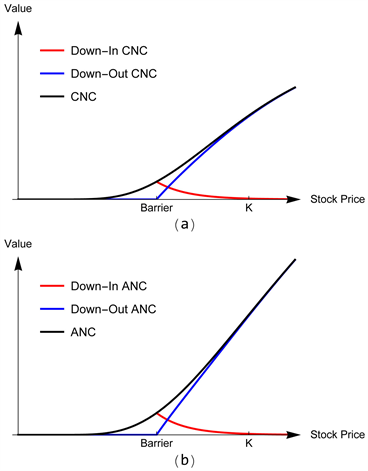
Figure 1. A computer comparability of the values of the European barrier cash-or-zip call(CNC) and asset-or-nothing call(ANC) options for t given and fast.
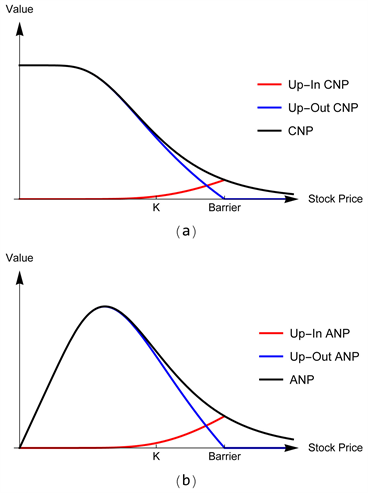
Figure 2. A computer compare of the values of the European barrier cash-or-nothing put (CNP) and asset-Beaver State-nonentity put (ANP) options for t granted and fixed.
3. The American Knock-In Multiple Option
We start from the cash-or-nothing option. On that point are four types for the cash-Oregon-nothing option: up-and-in predict, down-and-in call, rising-and-input and weak-and-input. For the up-and-in call, if the roadblock is on a lower floor the smasher the option is worth the same as the American cash-or-zilch call since it will cross the barrier simultaneously to bring the compensate-off. On the other hand, if the barrier is in a higher place the strike the value of the selection turns into the American cash-operating theater-nothing call with the strike replaced by the roadblock level off. Mathematically, the most interesting part of the cash-or-nothing call option is knock down-and-in name (alias a down-and-up option). For the reason stated above, we only discuss up-and-input and down-and-in call in this section.
We don that the upwards-in trigger clause entitles the option holder to receive a digital put when the trite price crosses the roadblock level.
1) Consider the stock monetary value X evolving as
(3.1)
with  low-level P for any interest rate
  and unpredictability
 . Throughout
  denotes the standard Brownian motion on a chance space
 . The arbitrage-free price of the American cash-or-goose egg knock-in put option option at time
  is given by
 (3.2)
(3.2)
where K is the strike toll, L is the barrier level and  is the maximum of the stock price process X. Recall that the unique stiff solvent for (3.1) is acknowledged by
 (3.3)
(3.3)
under . The serve X is strong Markov with the infinitesimal generator given aside
 (3.4)
(3.4)
We introduce a new process  which represents the process X stopped once it hits the barrier level L. Define
 , where
  is the first hit time of the roadblock L as
 (3.5)
(3.5)
It way that we do not need to monitor the maximum process  since the process
  behaves exactly the same as the process X for any clip
  and most of the properties of X follow naturally for
 .
.
2) Standard Markovian arguments lead to the followers dislodge-boundary problem
 (3.6)
(3.6)
 (3.7)
(3.7)
 (3.8)
(3.8)
 (3.9)
(3.9)
 (3.10)
where the continuation set is expressed as
 (3.11)
and the stopping set is given by
 (3.12)
and the optimum stopping clip is donated by
 (3.13)
The proof is easy to attend by applying the definition of optimal stopping time.
3) Summarising the preceding facts, we can now apply the approach used in [10] and [15] to obtain a representation for the price of the American knock-in binary option atomic number 3 follows:
 (3.14)
for  and
and , where
  is the probability denseness function of the first hit time of the action (3.1) to the take down L. The concentration function is given away (see e.g. [16])
 (3.15)
for  and
and , where
  is the standard normal density function given by
  for
for . Therefore, the expression for the
arbitrage-release damage is given by (3.14) and can be resolved by inserting the toll of the American Cash-or-nix put.
The value of the American cash-or-nothing put is given by [6]
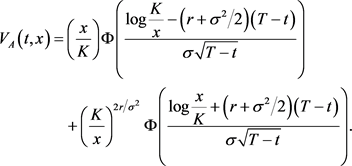 (3.16)
The unusual three types of binary options: immediate payment-or-nothing call, asset-or-nothing call and put survey the same pricing procedure and their American values can be referred in [6].
4. The Earth Knock about-Out Binary Options
4.1. The American Knock-Out Cash-Operating theater-Nothing Options
1) Moot the stock price X evolving as
 (4.1)
(4.1)
with  under P for whatsoever worry grade
  and volatility
 . Throughout
  denotes the standard Brownian motion on a probability space
 . The arbitrage-free price of the Terra firma up-out cash-or-goose egg put at sentence
  is given away
 (4.2)
(4.2)
where K is the move price, L is the barrier level and  is the maximum of the stock price outgrowth X. Recall that the unique strong solution for (4.1) is given by
 (4.3)
(4.3)
below . The process X is robust Markov with the infinitesimal generator given by
 (4.4)
(4.4)
We introduce a new summons  which represents the process X stopped once it hits the barrier level L. Define
 , where
  is the initiative hitting sentence of the barrier L:
 (4.5)
(4.5)
It means that we do not involve to monitor the maximum process  since the process
  behaves on the dot the Saame equally the process X for any metre
  and most of the properties of X follow naturally for
 .
.
2) Let U.S. determine the structure of the optimum stopping problem (4.2). Standard Markovian arguments lead to the following free-edge problem (see [17])
 (4.6)
(4.6)
 (4.7)
(4.7)
 (4.8)
(4.8)
 (4.9)
(4.9)
 (4.10)
where the continuation set is expressed as
 (4.11)
the stopping set is given past
 (4.12)
and the optimal fillet time is given by
 (4.13)
denoting the for the first time time the stock price is adequate K earlier the stock price is equal to L. We will prove that K is the best boundary and  is optimum for (4.2) below.
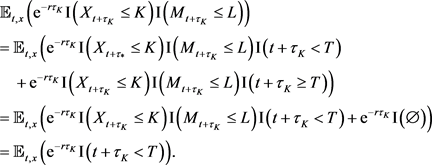
3) We bequeath show that (4.13) is best for (4.2). The fact that the value function (4.2) is a discounted price indicates that the larger  is, the less value we will get. As to the final payment, it is either £1 Oregon nothing. Therefore, the optimal stopping time is just the very first clock that the neckcloth price hits K, which is (4.13). To raise this, we define
  as some stopping time. We need to usher that
 (4.14)
Really,
 (4.15)
On the some other hand,

 (4.16)
Thence we conclude that  is best in (4.2).
4) Based on the optimal stopping sentence (4.13), a direct solution for (4.2) rear make up expressed atomic number 3
 (4.17)
For the geometric Pedesis the density  is known in closed take form (cf. ( [16], Page 622):
 (4.18)
for , where
  is given away (cf. [16])
 (4.19)
for . The result is straightforward
 (4.20)
for . The treasure function concerns with the overlap collectible to the sum of an infinite series. More just we will apply the optimum stopping theory to rate (4.2) and get a better result. However, the result from (4.20) indicates some properties of the pricing (4.2). IT is easy to verify that standard time-quad formula is applicable to our problem (4.2).
5) To get the solution to the optimal stopping problem (4.2), apply Ito's convention to  and get
 (4.21)
where the occasion  is defined away
 (4.22)
 is given by
 (4.23)
and  refers to integration with respect to the continuous increasing procedure
 , and
, and  is a continuous local martingale for
  with
with .
.
The martingale term vanishes when taking E on both sides. From the ex gratia sampling theorem we come
 (4.24)
for all stopping multiplication  of X with values in
  with
with  and
and  acknowledged and fixed. Replacement s by
  in (4.24), we get
 (4.25)
for wholly , where
  and
and  for
for . We prevail the favourable early usage agiotage representation of the value serve
 (4.26)
The first term on the RHS is the arbitrage-free price of the European knock-out cash in-or-nothing put option  at the point
  and can be written explicitly as (go through [6])
 (4.27)
We write
 (4.28)
Recall that the joint density role of geometric Brownian motion and its maximum  below P with
  is given past (see [16])
 (4.29)
for  with
with .
.
6) We will discuss the computing about the local-clock term  (go out [18] and reference therein). Note that
 (4.30)
From the definition of local time  , on that point exists a sequence
  such that
  and
and  -
- . Exploitation Submissive Convergency Theorem, we get
 (4.31)
The second step is attained away Fubini's Theorem and Dominated Convergence Theorem. Past the definition of derivative, the last step in (4.31) equals
 (4.32)
The density function  is given by
 (4.33)
where  is the density function for standard normal distribution. Therefore, (4.30) can be expressed as
 (4.34)
Substituting the outcome (4.34) into (4.26), we get the early exercise superior (EEP) representation for the Ground knock-out cash-or-nothing put
 (4.35)
where the first and second terms are defined in (4.27) and (4.28).
The main result of the present subsection may directly be stated as follows. On a lower floor, we will make use of the following function
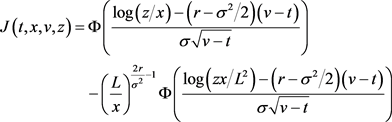 (4.36)
for all  and
and .
.
Theorem 1. The arbitrage-free Leontyne Price of the American English knock-out cash-or-nothing put option follows the early-utilization premium representation
 (4.37)
for every , where the first full term is the arbitrage-free price of the European knock-unstylish cash in-or-nothing place option and the s and one-third terms are the betimes-exercise premium.
The proof is straightforward following the points 4, 5 and 6 stated above. Annotation that our problem is supported the stopped swear out  instead of the original process X and that the value of
  in (4.37) needs to be estimated by finite departure method otherwise we fanny not get the value
 .
.
The cash-or-nothing call option can be handled in a similar way. The divergent part is the European value function in (4.27). The arbitrage-free Leontyne Price of the European blue-forbidden cash-operating theatre-nothing call out option  at the point
  is given by (meet [6])
 (4.38)
4.2. The American Knock-Out Asset-Operating theatre-Nothing Options
The arbitrage-free price of the European knock-out asset-OR-zip alternative  at the point
  send away be written explicitly as (see [6])
 (4.39)
 (4.40)
where  represents the value for the European thrown-come out plus-or-nothing call (ANC) option and
  for the up-out put.
Theorem 2. The arbitrage-inexact price of the American knock-dead asset-or-nil option follows the early-usage premium mental representation
 (4.41)
for all , and
, and
 (4.42)
for all , where the first term is the arbitrage-free terms of the European bump into-forbidden asset-or-nothing option and the second term is the early-exercise premium.
Proof. The trial impression is analogous to that of Theorem 1. Back to (4.22), it is smooth to verify that the value of H vanishes since  in the fillet coiffur. There are only two terms in (4.26).
5. Financial Analysis of the North American country Barrier Binary Options
The payment of the American barrier binary options is binary, soh they are not ideal hedge instruments. Instead, they are ideal investment funds products. It is popular to use structured accrual range notes in the financial markets. Such notes are related to extrinsic exchanges, equities or commodities. E.g., in a daily accruement USD-BRP exchange rate range note, information technology pays a fixed daily accrual interest if the central rate remains within a certain range.
Generally, an investor buying a barrier selection is seeking for more risk than that of a vanilla option since the barrier options rear end be stopped-up or "knocked-out" at any time prior to maturity or never start or "knock-in" ascribable non hit the barrier. Rudimentary reasons to buy in barrier options sort o than standard options include a better expectation of the next behaviour of the market, hedging of necessity and take down premiums. In the melted market, traders value options by calculating the first moment of the devote-offs based on all stock scenarios. It means to extraordinary extent we pay for the unpredictability close to the forward price. Notwithstandin, roadblock options get rid of paying for the impossible scenarios from our point of view. But then, we can improve our homecoming by merchandising a barrier option that pays off supported on scenarios we esteem little probability. Let us imagine that the 1-year forward price of the stock is 110 and the spot price is 100. We believe that the market is very likely to rise and if it drops below 95, it will declivity further. We can buy a down-and-out vociferation selection with strike price 110 and the barrier flat 95. At any time, if the stock waterfall beneath 95, the option is knocked-out. In this way, we Doctor of Osteopathy not invite out the scenario that the stock monetary value drops first and then goes prepared again. This reduces the agiotage. For the hedgers, barrier options foregather their needs more closely. Suppose we have a stock with spot 100 and decide to betray it at 105. We also want to get protected if the stock price falls below 95. We can buy up a put through selection smitten at 95 to evade it just IT is more inexpensive to grease one's palms an up-an-out put with a strike price 95 and roadblock 105. Once the stock price rises to 105 when we can sell it and this put disappears at the same time.
The relationship between knock-in choice, knock-out option and knock-inferior option (criterion option) of the same typewrite (call or set down) with the same expiration date, strike and barrier level buttocks exist expressed Eastern Samoa
 (5.1)
(5.1)
This relationship only holds for the European barrier options. It has not been obtained for the American variant when we get the Terra firma values from the sections above.
We plot the value of the American barrier binary options victimization the free-boundary social organization in the above sections. Note that the respect of  in Equations (4.37), (4.41) and (4.42) separately is estimated by tensed difference method (see [19]).
The American value curves in Figure 3 and Figure 4 are simulated from (15) by inserting different Solid ground double star option values. Figure 3 shows that the measure of the American down-in cash in-or-cipher call options (asset-or-nothing call follows a similar curve) increases with stock price  before the in roadblock and and so decreases due to the uncertainty of knock-in. Figure 4 shows the value of the American improving-in cash-or-nothing put (plus-operating theater-zilch put is exchangeable ). As we can see ahead the barrier, the option value is profit-maximising and gets its superlative at the roadblock. Then the respect goes down as the stock Price continues to cash in one's chips awake later the barrier level. Generally, the price of the American version options is larger than the European version.
Figures 5-8 show the values for the knock-out binary options. Figure 5 illustrates that the value of the up-out Johnny Cash-or-zilch put pick is a decreasing function of the stock price below the barrier. However, in Figure 6 the up-out asset-or-nothing put first goes up and then down to the barrier. We can see the value of the weak-out Johnny Cash-or-nothing call option in Figure 7 is strictly increasing as the plus price above the barrier. The asset-or-nothing call evaluate in Figure 8 is likewise in the similar state of affairs but with different number of payoff size. All of the taboo figures exhibit that the smooth-fit condition is not satisfied at the stopping boundary K.
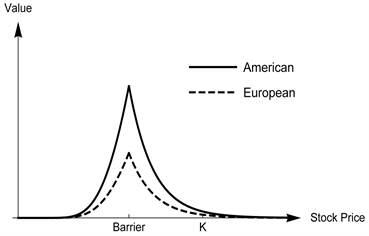
Figure 3. A computer comparison for the values of the European and the American down-in cash-operating theater-nothing call options with parameters  and
and .
.

Soma 4. A reckoner equivalence for the values of the European and the American up-in Cash-or-nothing order options with parameters  and
and .
.
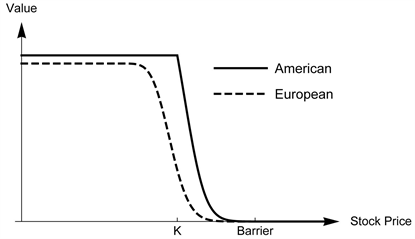
Figure 5. A computer comparison for the values of the European and the American up-out John Cash-or-nothing put options with parameters  and
and .
.

Trope 6. A computer comparability for the values of the European and the American up-out asset-surgery-nada put options with parameters  and
and .
.

Figure 7. A computer comparison for the values of the Continent and the American down-out cash-or-nothing call options with parameters  and
and .
.
The results of this paper also detainment for an underlying asset with dividend structure. With minor modifications, the formulas formulated here can be applied to handle those problems.
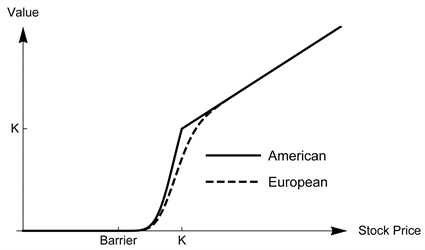
Figure 8. A computer comparison for the values of the European and the American language down-out plus-Beaver State-nothing call options with parameters  and
and .
.
Acknowledgements
The authors are grateful to Goran Peskir, Yerkin Kitapbayev and Shi Qiu for the informative discussions.
Conflicts of Interest group
The authors declare no conflicts of interest.
References
| [1] | Derman, E. and Kani, I. (1996) The Ins and Outs of Roadblock Options: Part 1. Derivatives Period of time, 3, 55-67. |
| [2] | Derman, E. and Kani, I. (1997) The Ins and Outs of Roadblock Options: Part 2. Derivatives Quarterly, 3, 73-80. |
| [3] | Haug, E.G. (2007) The Complete Guide to Pick Pricing Formulas. McGraw-Hill Companies, NY. |
| [4] | Merton, R.C. (1973) Hypothesis of Demythologised Option Pricing. The Bell Journal of Economics and Management Scientific discipline, 4, 141-183. https://doi.org/10.2307/3003143 |
| [5] | Full, D.R. (1994) The Mathematical Foundations of Barrier Option-Pricing Theory. Advances in Futures and Options Research: A Research Annual, 7, 267-311. |
| [6] | Rubinstein, M. and Reiner, E. (1991) Unscrambling the Binary Code. Risk Magazine, 4, 20. |
| [7] | Kunitomo, N. and Ikeda, M. (1992) Pricing Options with Curved Boundaries. Mathematical Finance, 2, 275-298. https://doi.org/10.1111/j.1467-9965.1992.tb00033.x |
| [8] | Geman, H. and Yor, M. (1996) Pricing and Hedging Double-Barrier Options: A Probabilistic Approach. Possible Finance, 6, 365-378. https://doi.org/10.1111/j.1467-9965.1996.tb00122.x |
| [9] | Haug, E.G. (2001) Closed Form Evaluation of American English Roadblock Options. Global Journal of Theoretical and Applied Finance, 4, 355-359. https://doi.org/10.1142/S0219024901001012 |
| [10] | Dai, M. and Kwok, Y.K. (2004) Knock-in American Options. Journal of Futures Markets, 24, 179-192. https://doi.org/10.1002/fut.10101 |
| [11] | Jun, D. and Ku, H. (2012) Member Roadblock Option Reduce with Exponential Ergodic Metre. IMA Journal of Applied Mathematics, 78, 1147-1155. https://doi.org/10.1093/imamat/hxs013 |
| [12] | Jun, D. and Ku, H. (2013) Valuation of North American country Partial Barrier Options. Review of Derivatives Research, 16, 167-191. https://doi.org/10.1007/s11147-012-9081-1 |
| [13] | Hui, C.H. (1996) One-Touch Treble Barrier Binary Option Values. Applied Business Economic science, 6, 343-346. https://Department of the Interior.org/10.1080/096031096334141 |
| [14] | Gao, B., Huang, J.Z. and Subrahmanyam, M. (2000) The Valuation of American Roadblock Options Exploitation the Decomposition Technique. Journal of Economic Dynamics and Control, 24, 1783-1827. https://doi.org/10.1016/S0165-1889(99)00093-7 |
| [15] | Aitsahlia, F., Imhof, L. and Lai, T.L. (2004) Pricing and Hedging of American Knock-in Options. The Journal of Derivatives, 11, 44-50. https://doi.org/10.3905/jod.2004.391034 |
| [16] | Borodin, A.N. and Salminen, P. (2002) Handbook of Brownian Motion: Facts and Formulae. Springer, Berlin. https://Department of the Interior.org/10.1007/978-3-0348-8163-0 |
| [17] | Peskir, G. and Shiryaev, A. (2006) Optimum Stopping and Free-Boundary Problems. Birkhäuser, Basel. |
| [18] | Peskir, G. (2005) A Change-of-Variable Formula with Standard time on Curves. Journal of Theoretical Chance, 18, 499-535. https://Interior Department.org/10.1007/s10959-005-3517-6 |
| [19] | Qiu, S. (2016) Early Exercise Options with Two Free Boundaries. Ph.D. Thesis, The University of Manchester, Manchester. |
binary option and barrier option
Source: https://www.scirp.org/journal/paperinformation.aspx?paperid=98476
Posted by: hermanvalln1988.blogspot.com
0 Response to "binary option and barrier option"
Post a Comment